
By SZSUNLIT Technical Team
Selecting the right mini magnetic drive gear pump requires more than matching a flow rate or choosing the highest available pressure rating. A reliable pump must be compatible with the liquid, operate efficiently under the required conditions, and integrate properly with the complete fluid-handling system.
For OEM equipment manufacturers, design engineers, and system integrators, incorrect pump selection can lead to insufficient flow, excessive motor loading, cavitation, premature component wear, or unexpected downtime.
This guide explains how to select a miniature magnetic drive gear pump based on flow rate, differential pressure, viscosity, temperature, materials, suction conditions, and motor control. It also compares the SZSUNLIT PRO and LITE series to help engineers identify a suitable solution for their applications.
1. What Is a Mini Magnetic Drive Gear Pump?
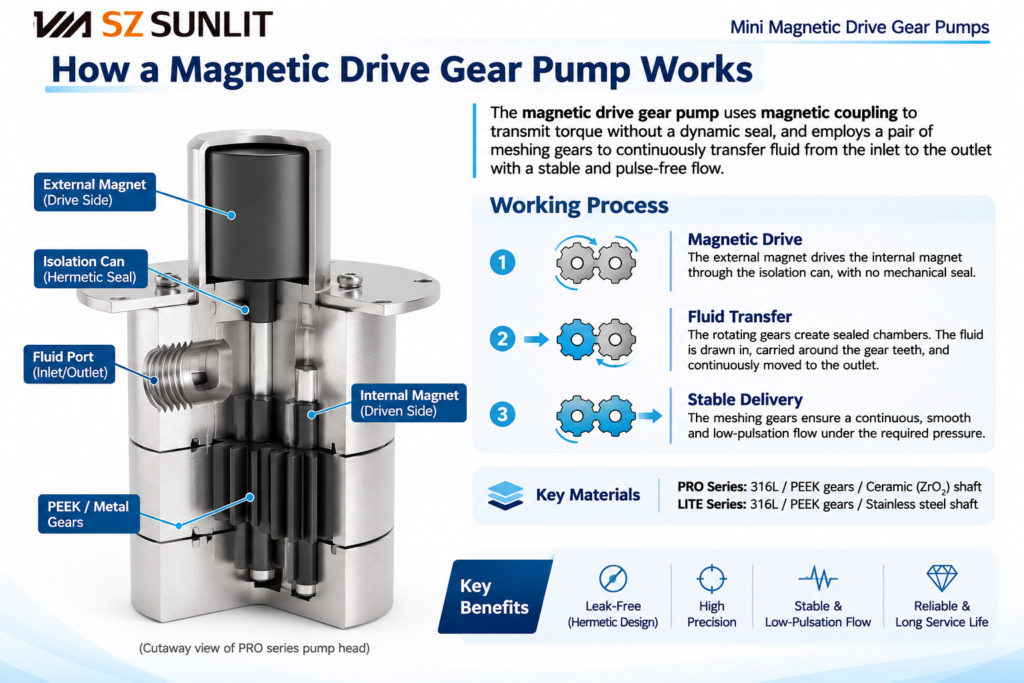
A mini magnetic drive gear pump is a compact positive displacement pump that transfers liquid using rotating gears.
As the gears rotate, liquid enters the pump inlet, moves through the spaces between the gear teeth and housing, and is discharged through the outlet.
Unlike conventional pumps with mechanical shaft seals, magnetic drive gear pumps transmit torque through a magnetic coupling. This eliminates the need for a rotating shaft to penetrate the sealed pump chamber.
Key Advantages
Sealless construction
Magnetic coupling eliminates conventional dynamic shaft seals, helping reduce external leakage risks and maintenance requirements.
Compact OEM integration
Miniature gear pumps can be incorporated into equipment where installation space is limited.
Adjustable flow
Flow can be regulated by changing rotational speed, although actual delivery also depends on viscosity and differential pressure.
Positive displacement operation
Gear pumps are useful for applications requiring relatively small, controlled flow rates against system resistance.
Flexible motor configurations
Depending on the model, pumps can be equipped with brushless DC, stepper, servo, or three-phase AC motors.
Miniature magnetic drive gear pumps are used in applications such as chemical transfer, liquid cooling, laboratory equipment, filling systems, fluid metering, and industrial automation.
However, not every magnetic gear pump is suitable for every liquid or operating condition.
Correct selection begins with understanding the application.
2. Identify the Liquid Before Selecting the Pump
The first step is to understand the properties of the liquid being transferred.
Two applications requiring the same flow rate may need different pumps because of differences in viscosity, chemical compatibility, temperature, and lubricating properties.
| Fluid Property | Why It Matters |
|---|---|
| Chemical composition | Determines wetted-material compatibility |
| Viscosity | Influences flow, internal leakage, and motor torque |
| Density | Affects hydraulic power calculations |
| Temperature | Changes viscosity and material behavior |
| Vapor pressure | Influences cavitation and suction requirements |
| Lubricating properties | Affect wear and component life |
| Particle content | May cause abrasion, blockage, or seizure |
Low-Viscosity Liquids
Low-viscosity liquids, such as certain solvents and refrigerants, can increase internal leakage through the clearances between gears and housing.
This may reduce volumetric efficiency, particularly at higher differential pressures.
Some low-viscosity liquids also provide limited lubrication, making internal material selection especially important.
High-Viscosity Liquids
Higher viscosity generally reduces internal leakage but increases resistance to flow and the torque required to drive the pump.
For viscous oils, resins, or similar liquids, engineers should carefully evaluate motor torque, startup temperature, suction conditions, and rotational speed.
Engineering Tip: Always provide viscosity at the actual operating temperature. A viscosity value measured at room temperature may differ significantly from the value during operation.
3. How to Calculate Mini Gear Pump Flow Rate
Flow rate is one of the most important selection parameters.
However, pump displacement and actual delivered flow are not identical.
Understanding Pump Displacement
Pump displacement represents the theoretical liquid volume transferred per revolution.
It is commonly expressed in milliliters per revolution (mL/rev).
For example, a pump with a displacement of 1.0 mL/rev theoretically transfers 1.0 mL of liquid during each complete revolution.
Theoretical Flow Rate Formula
Qₜ = Vg × n
Where:
- Qₜ = Theoretical flow rate (mL/min)
- Vg = Pump displacement (mL/rev)
- n = Rotational speed (rpm)
Example: A Pump Delivering 2 L/min
Suppose the application requires:
- Target flow rate: 2 L/min
- Pump displacement: 1.0 mL/rev
Convert the flow rate:
2 L/min = 2,000 mL/min
Calculate theoretical speed:
n = 2,000 ÷ 1.0
Required theoretical speed = 2,000 rpm
However, this calculation assumes no internal leakage.
Actual Flow and Volumetric Efficiency
In real operation, some liquid may leak internally from the high-pressure side to the low-pressure side.
Actual flow can be estimated using:
Qactual = Vg × n × ηv
Where ηv represents volumetric efficiency.
For example, assuming an illustrative volumetric efficiency of 85%:
Qactual = 1.0 × 2,000 × 0.85
Actual flow = 1,700 mL/min = 1.7 L/min
To theoretically achieve 2 L/min under the same assumed efficiency:
n = 2,000 ÷ (1.0 × 0.85)
Required speed ≈ 2,353 rpm
The 85% volumetric efficiency is used only to demonstrate the calculation. It is not a verified performance figure for a particular SZSUNLIT model.
Why Performance Curves Are Important
Actual flow depends on several operating parameters:
- Differential pressure
- Liquid viscosity
- Temperature
- Rotational speed
- Internal clearances
- Pump displacement
As differential pressure increases, internal leakage may increase, reducing delivered flow.
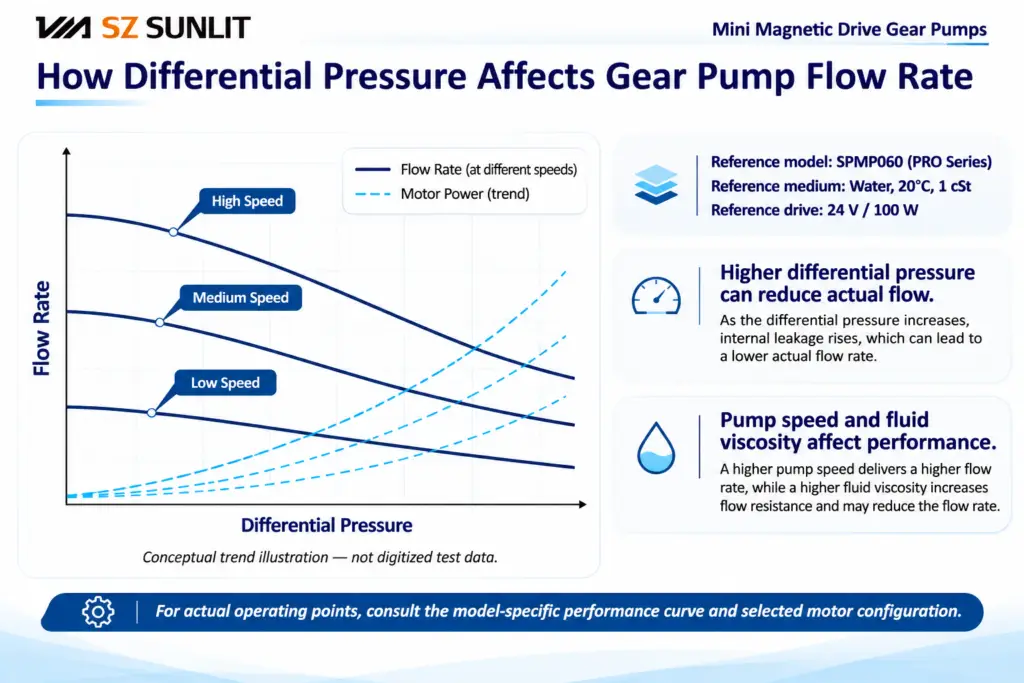
Therefore, engineers should select a pump using performance data that represents the intended operating conditions.
SZSUNLIT provides model-specific performance information for the PRO Series Magnetic Drive Gear Pumps, including flow behavior at different speeds and differential pressures.
4. Understand Differential Pressure and System Pressure
A common pump selection mistake is confusing differential pressure with maximum system pressure.
These are two different engineering parameters.
What Is Differential Pressure?
Differential pressure is the difference between the pump outlet and inlet pressures.
ΔP = Pout − Pin
Where:
- ΔP = Differential pressure
- Pout = Outlet pressure
- Pin = Inlet pressure
Example
Suppose a system operates at:
- Inlet pressure: 2 bar(g)
- Outlet pressure: 12 bar(g)
The differential pressure is:
ΔP = 12 − 2
ΔP = 10 bar
The pump must therefore operate against a 10 bar pressure differential.
What Is Maximum System Pressure?
Maximum system pressure refers to the pressure that the pump’s pressure-containing components are designed to withstand under specified conditions.
A pump’s maximum allowable system pressure is not necessarily the same as its maximum allowable differential pressure.
Both specifications must be checked.
SZSUNLIT PRO Series Pressure Capability
The SZSUNLIT PRO Series has a standard differential pressure capability of up to 20 bar, depending on the selected model.
For applications requiring higher differential pressure, customized configurations supporting up to 40 bar may be available for selected models, subject to engineering evaluation.
Customized system-pressure configurations up to 50 bar may also be available.
These are not universal ratings for every PRO model.
The appropriate configuration depends on displacement, liquid properties, temperature, rotational speed, and duty cycle.
SZSUNLIT LITE Series Pressure Capability
The LITE Series supports differential pressures up to 18 bar on selected models, with model-dependent system-pressure capability up to 30 bar.
Lower-displacement and other configurations may have lower allowable pressure limits.
Engineering Tip: Always specify inlet pressure, outlet pressure, and whether the values are absolute or gauge pressures.
Positive displacement pump systems must also include appropriate overpressure protection.
5. How Viscosity and Temperature Affect Pump Performance
Viscosity and temperature are closely related.
For many liquids, viscosity decreases as temperature increases.
This can significantly influence pump flow, motor loading, and internal wear.
Effects of Low Viscosity
Potential concerns include:
- Increased internal leakage
- Reduced volumetric efficiency
- Insufficient lubrication
- Greater sensitivity to differential pressure
Effects of High Viscosity
Potential concerns include:
- Increased motor torque
- Higher suction resistance
- Greater startup loading
- Increased power consumption
For high-viscosity liquids, reducing pump speed may help manage suction losses and mechanical loading, provided the required flow can still be achieved.
Why Temperature Matters
Temperature influences more than viscosity.
It may also affect:
- Thermal expansion of internal components
- Gear and housing clearances
- Static sealing materials
- Magnetic coupling performance
- Motor and electronic component temperatures
- Long-term material stability
For example, a pump head designed for elevated liquid temperatures does not automatically mean that its motor or electronic driver can operate at the same temperature.
The complete pump assembly must be evaluated.
SZSUNLIT Temperature Capabilities
PRO Series
Standard configurations support a temperature range of −80°C to +140°C, depending on the selected model and materials.
Specialized configurations for temperatures from −120°C to +170°C can be evaluated for customized applications.
LITE Series
The standard operating temperature range is −20°C to +70°C.
For applications outside these limits, the PRO Series may be a more suitable starting point.
6. Check Suction Conditions and Cavitation Risk
Suction conditions are particularly important for volatile liquids, refrigerants, and applications with limited inlet pressure.
Inadequate suction conditions can cause unstable flow, vapor formation, noise, and premature component damage.
What Is Cavitation?
Cavitation occurs when local liquid pressure falls below the liquid’s vapor pressure, allowing vapor bubbles to form.
These bubbles may collapse in higher-pressure regions, potentially damaging internal components.
Understanding NPSH
NPSH stands for Net Positive Suction Head.
Two terms are commonly used:
NPSHa — Net Positive Suction Head Available
The suction head available from the system.
NPSHr — Net Positive Suction Head Required
The suction head required by the pump under specified test and operating conditions.
For reliable operation, the system must provide adequate NPSHa relative to the applicable NPSHr, including an appropriate margin.
Practical Suction Design Recommendations
- Keep inlet piping as short as practical.
- Avoid unnecessary elbows and restrictions.
- Use appropriately sized suction pipes.
- Minimize pressure losses across filters.
- Prevent trapped air and vapor accumulation.
- Evaluate liquid vapor pressure at operating temperature.
- Maintain adequate liquid supply at the pump inlet.
For volatile liquids, additional consideration may be required for subcooling, inlet pressure, and vapor management.
Important: A pump’s suction capability does not automatically guarantee cavitation-free operation.
Applications involving refrigerants or other volatile liquids require specific engineering evaluation.
7. Choose Compatible Pump Materials
Material compatibility is essential for long-term reliability.
Miniature gear pumps often have small internal clearances, making them sensitive to material swelling, deformation, contamination, and wear.
316L Stainless Steel Pump Housing
316L stainless steel offers useful mechanical strength and corrosion resistance in many industrial fluid-handling applications.
However, compatibility depends on the specific chemical, concentration, temperature, and operating conditions.
PEEK Gears
PEEK (Polyether Ether Ketone) is a high-performance engineering polymer used in precision mechanical applications.
Its properties include:
- Good mechanical strength
- Dimensional stability
- Resistance to many chemicals
- Useful wear properties under suitable operating conditions
Actual suitability must be verified for the specific liquid and loading conditions.
Zirconia Ceramic Shafts
Zirconia ceramic (ZrO₂) is used in selected high-performance pump configurations because of its hardness, wear-related properties, and dimensional stability.
The SZSUNLIT PRO Series uses zirconia ceramic shaft construction.
Stainless Steel and Ceramic Shaft Options
The SZSUNLIT LITE Series offers stainless steel or ceramic shaft configurations, depending on the selected model.
This provides flexibility for different operating and commercial requirements.
Static Sealing Materials
Static seals must also be compatible with the liquid.
Depending on the pump configuration, sealing material options may include FKM, EPDM, or other suitable materials.
Selection Tip: Chemical compatibility should be checked for every wetted component, not only the pump housing.
8. Select the Right Motor and Speed Control
Different applications require different motor configurations.
A pump used for simple liquid transfer may not require the same control system as a precision dosing application.
Brushless DC Motors (BLDC)
Brushless DC motors are commonly used in compact OEM equipment.
They offer electronic speed control and can be suitable for adjustable-flow applications.
Three-Phase AC Motors with VFD
Three-phase AC motors can be combined with variable frequency drives to adjust rotational speed.
This configuration may be appropriate for industrial systems requiring variable flow.
Motor cooling, torque capability, allowable frequency range, and electrical requirements must be considered.
Stepper Motors
Stepper motors may be suitable for applications requiring controlled incremental motion or repeatable speed commands.
However, motor positioning accuracy does not automatically guarantee liquid dosing accuracy.
Servo Motors
Servo motors provide closed-loop motion control and can be considered for applications requiring precise motor speed regulation.
For high-accuracy dosing, flow measurement or calibration may still be required.
Motor Selection Guide
| Application | Motor Configuration to Evaluate |
|---|---|
| General fluid transfer | BLDC or AC motor |
| Adjustable circulation | BLDC or VFD-controlled AC |
| Controlled incremental dosing | Stepper motor |
| High-performance speed control | Servo motor |
| Hazardous-area installation | Appropriately certified motor and system |
For hazardous-area applications, certification requirements must be evaluated for the complete installation. A certified motor alone does not establish certification of the entire pump assembly.
9. SZSUNLIT PRO vs. LITE: Which Magnetic Drive Gear Pump Should You Choose?
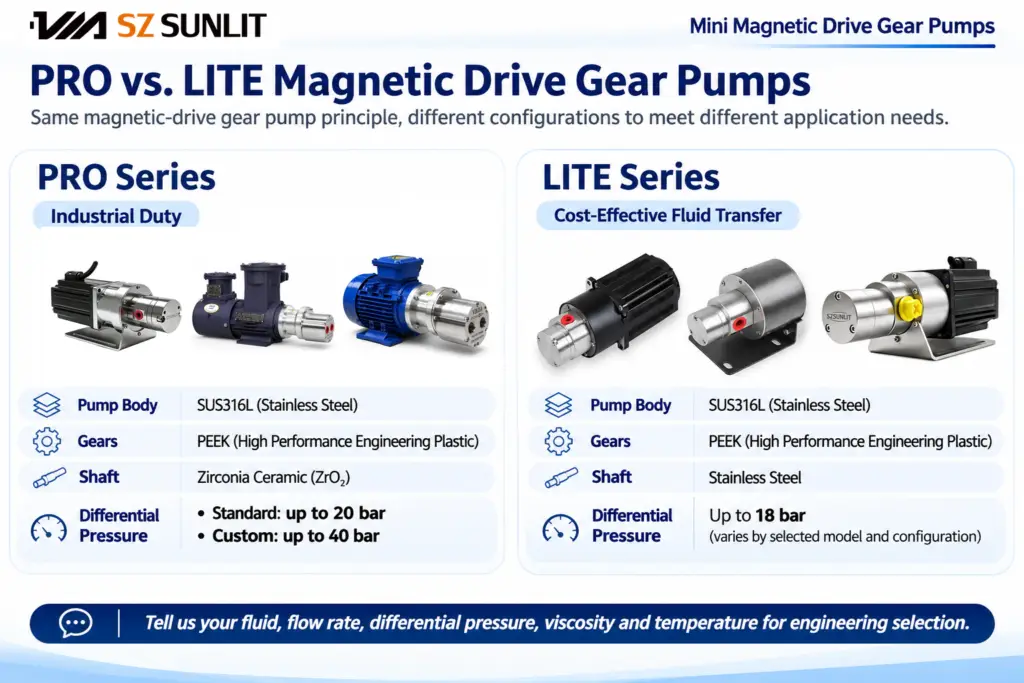
SZSUNLIT offers two miniature magnetic drive gear pump series for different performance requirements, operating conditions, and OEM integration needs.
Both series use sealless magnetic drive technology, but they differ in pressure capability, temperature range, material configuration, and product positioning.
SZSUNLIT PRO Series — High-Performance Magnetic Drive Gear Pumps
The SZSUNLIT PRO Series Magnetic Drive Gear Pumps are designed for demanding industrial fluid-handling applications requiring higher pressure capability, wider operating temperatures, and specialized configurations.
Key Specifications
- Displacement: 0.2–26 mL/rev
- Standard differential pressure: Up to 20 bar, model-dependent
- Customized differential pressure: Up to 40 bar on selected models
- Customized maximum system pressure: Up to 50 bar
- Standard operating temperature: −80°C to +140°C, configuration-dependent
- Customized temperature range: −120°C to +170°C, subject to engineering confirmation
- Viscosity range: 0–10,000 cP
- Pump housing: 316L stainless steel
- Gear material: PEEK
- Shaft material: Zirconia ceramic
- Motor options: Brushless DC, stepper, servo, and selected three-phase configurations
Additional pump-body material options can be evaluated for specific chemical compatibility requirements.
The PRO Series is worth considering for demanding chemical transfer, specialized thermal management, continuous-duty industrial fluid handling, and applications requiring higher differential pressure.
Standard vs. Customized Pressure Capability
The standard PRO Series supports differential pressure up to 20 bar on applicable models.
For requirements above 20 bar, SZSUNLIT can evaluate customized configurations up to 40 bar on selected models.
These higher-pressure configurations require confirmation of the pump model, liquid, temperature, motor torque, and duty cycle.
Explore PRO Series Technical Specifications and Performance Curves
SZSUNLIT LITE Series — Compact and Cost-Effective Magnetic Drive Gear Pumps
The SZSUNLIT LITE Series Magnetic Drive Gear Pumps are designed for compact OEM equipment, precision filling, dispensing, metering, and general fluid-transfer applications.
The LITE Series focuses on practical performance, flexible integration, and cost efficiency.
Key Specifications
- Displacement: 0.07–50 mL/rev
- Differential pressure: Up to 18 bar, model-dependent
- Maximum system pressure: Up to 30 bar, model-dependent
- Operating temperature: −20°C to +70°C
- Viscosity range: 0–3,000 cP
- Pump housing: 316L stainless steel
- Gear material: PEEK
- Shaft material: Stainless steel or ceramic, depending on configuration
- Gear design: Helical gear
- Motor options: Brushless DC, stepper, servo, and selected three-phase configurations
The LITE Series can be considered for:
- Filling and dispensing equipment
- Chemical dosing systems
- Laboratory instruments
- Analytical equipment
- Cosmetic and personal-care production
- Compact OEM fluid-transfer systems
For precision metering, final dosing accuracy depends on pump calibration, fluid properties, operating pressure, and the control system.
Explore LITE Series Models and Technical Specifications
PRO vs. LITE: Technical Comparison
| Parameter | PRO Series | LITE Series |
|---|---|---|
| Displacement | 0.2–26 mL/rev | 0.07–50 mL/rev |
| Standard differential pressure | Up to 20 bar | Up to 18 bar |
| Customized differential pressure | Up to 40 bar, selected models | Application-specific evaluation |
| Maximum system pressure | Up to 50 bar, customized | Up to 30 bar |
| Standard temperature | −80°C to +140°C | −20°C to +70°C |
| Viscosity | Up to 10,000 cP | Up to 3,000 cP |
| Gear material | PEEK | PEEK |
| Shaft material | Zirconia ceramic | Stainless steel / ceramic |
| Gear design | Spur gear standard | Helical gear |
| Primary positioning | Demanding industrial applications | Compact, cost-effective OEM applications |
All performance limits depend on the selected model, materials, liquid properties, and operating conditions. Maximum specifications should not be assumed to apply simultaneously.
When Should You Choose PRO?
Consider the PRO Series when:
- The application requires higher differential pressure.
- Operating temperatures exceed LITE limits.
- Zirconia ceramic shaft construction is preferred.
- Specialized material or motor configurations are required.
- Long-term operation under demanding conditions is a priority.
When Should You Choose LITE?
Consider the LITE Series when:
- Compact integration is important.
- The application involves filling, dispensing, metering, or general fluid transfer.
- Operating conditions fall within the selected LITE model’s limits.
- Cost efficiency is a major consideration.
- Higher PRO pressure and temperature capabilities are unnecessary.
SZSUNLIT Recommendation: Select the series according to actual operating requirements rather than automatically choosing the highest-specification pump.
10. Filtration, Piping, and Dry-Running Considerations
Miniature gear pumps contain small internal clearances.
Contamination, crystallized deposits, and solid particles can cause excessive wear, reduced performance, or mechanical seizure.
Filtration
Before installation:
- Flush new piping.
- Check the cleanliness of the liquid.
- Select suitable inlet filtration.
- Consider pressure loss across the filter.
- Establish an appropriate maintenance schedule.
Very fine filtration may protect internal components but can also increase suction resistance.
The filter should be selected based on the actual liquid and pump operating conditions.
Can a Magnetic Gear Pump Run Dry?
Dry-running tolerance varies by pump design and operating conditions.
Some configurations may tolerate limited dry-running under defined conditions, but this should never be assumed for all models.
Dry-running may increase friction, temperature, and component wear.
Always confirm the permitted speed, duration, and operating conditions before allowing dry-running.
Can a Magnetic Gear Pump Operate in Reverse?
Certain pump configurations may support reverse rotation.
However, reverse-flow performance, allowable differential pressure, and operating duration must be confirmed for the selected model.
11. Common Mistakes When Selecting a Mini Magnetic Drive Gear Pump
Mistake 1: Selecting Only by Maximum Flow Rate
A pump’s maximum theoretical flow does not necessarily represent its delivered flow at the required differential pressure.
Mistake 2: Confusing System Pressure with Differential Pressure
Both parameters must be evaluated independently.
Mistake 3: Ignoring Viscosity
Viscosity affects internal leakage, motor torque, suction resistance, and efficiency.
Mistake 4: Overlooking Startup Temperature
A liquid may become significantly more viscous at lower temperatures, increasing startup torque.
Mistake 5: Selecting an Undersized Motor
The motor and magnetic coupling must provide sufficient torque for the required operating conditions.
Mistake 6: Ignoring Suction Conditions
Inadequate inlet pressure or excessive suction resistance may cause vapor formation and unstable flow.
Mistake 7: Assuming Speed Control Guarantees Dosing Accuracy
Actual liquid delivery varies with pressure, viscosity, temperature, and internal leakage.
Accurate metering may require calibration or closed-loop feedback.
12. Mini Magnetic Drive Gear Pump Selection Checklist
Before requesting a pump recommendation, prepare the following operating information.
| Parameter | Information Required |
|---|---|
| Liquid | Exact name and composition |
| Application | Transfer, circulation, dosing, or metering |
| Flow rate | Minimum, normal, and maximum |
| Inlet pressure | bar(a) or bar(g) |
| Outlet pressure | bar(a) or bar(g) |
| Differential pressure | Normal and maximum |
| Viscosity | cP or mPa·s at operating temperature |
| Liquid temperature | Minimum, normal, and maximum |
| Ambient temperature | Equipment operating environment |
| Duty cycle | Continuous or intermittent |
| Power supply | Voltage and AC/DC requirements |
| Motor control | Fixed or adjustable speed |
| Connections | Port size and thread type |
| Installation | Available space and mounting requirements |
| Special requirements | Materials, certification, or other constraints |
Providing complete operating conditions helps reduce selection errors and unnecessary engineering revisions.
13. Frequently Asked Questions
What is the difference between a magnetic drive gear pump and a centrifugal pump?
A magnetic drive gear pump is a positive displacement pump that transfers a theoretical volume of liquid per revolution.
A centrifugal pump uses an impeller to transfer energy to the liquid.
Gear pumps are often considered for controlled low-flow applications requiring significant differential pressure, while centrifugal pumps are commonly used for many higher-flow circulation applications.
The correct choice depends on the operating conditions.
How do I calculate the flow rate of a mini gear pump?
The theoretical flow rate is:
Flow rate = Displacement × Rotational speed
Actual flow is generally lower because of internal leakage.
Performance data should be evaluated at the required pressure, viscosity, and temperature.
What is the maximum pressure of SZSUNLIT PRO magnetic gear pumps?
The standard PRO Series supports differential pressure up to 20 bar, depending on the model.
Customized configurations supporting up to 40 bar differential pressure may be available on selected models, subject to engineering confirmation.
What is the maximum pressure of SZSUNLIT LITE magnetic gear pumps?
The LITE Series supports differential pressure up to 18 bar on selected models.
Actual allowable pressure depends on displacement and configuration.
Can magnetic drive gear pumps operate continuously?
Certain magnetic gear pump configurations are designed for continuous-duty applications.
Continuous operation must be verified for the complete pump and motor assembly under the intended operating conditions.
Can a magnetic drive gear pump handle high-viscosity liquids?
Yes, suitable gear pump configurations can handle viscous liquids.
The SZSUNLIT PRO Series supports applications with viscosity up to 10,000 cP, subject to model and operating-condition limitations.
Motor torque, suction conditions, temperature, and rotational speed must be evaluated.
Are magnetic drive gear pumps suitable for chemical transfer?
They may be suitable when the liquid is compatible with all wetted materials and the operating conditions are within the pump’s specified limits.
Chemical compatibility must be verified for the complete pump assembly.
Can I adjust pump flow by changing motor speed?
Yes. Gear pump flow generally changes with rotational speed.
However, actual flow also depends on differential pressure, viscosity, temperature, and internal leakage.
Which is better, PRO or LITE?
Neither series is universally better.
PRO is designed for more demanding pressure, temperature, and material requirements.
LITE is designed for compact, cost-effective filling, metering, and fluid-transfer applications.
The appropriate choice depends on the specific application.
Conclusion: Select the Pump for the Complete System
Selecting the right mini magnetic drive gear pump requires a complete understanding of the application.
Flow rate and pressure are important, but they are only part of the selection process.
Fluid compatibility, viscosity, temperature, suction conditions, motor torque, speed control, and duty cycle must also be considered.
A properly selected pump can improve operating stability, reduce unnecessary maintenance, and support long-term equipment reliability.
At SZSUNLIT, we provide miniature magnetic drive gear pump solutions for OEM equipment manufacturers, system integrators, and industrial fluid-handling applications.
Our PRO and LITE series offer different combinations of performance, materials, and configuration flexibility to match specific operating requirements.
Explore SZSUNLIT Magnetic Drive Gear Pumps
PRO Series — High-Performance Magnetic Drive Gear Pumps
Explore our PRO Series for demanding industrial applications, wider temperature requirements, and customized high-pressure solutions.
LITE Series — Compact Magnetic Drive Gear Pumps
Discover compact and cost-effective solutions for filling, metering, dosing, and OEM fluid transfer.
Need Help Selecting the Right Pump?
Send us your operating requirements, including:
- Liquid name and viscosity
- Required flow rate
- Inlet and outlet pressure
- Operating temperature
- Power supply and speed-control requirements
- Installation and connection details
Our technical team will review your application and recommend a suitable pump configuration.
Contact SZSUNLIT
Website: https://www.szsunlitgroup.com/
Email: ivy@szsunlittools.com
Find the Right Magnetic Drive Gear Pump for Your Application — Request an Engineering Review.

